What Is a Website Audit? (And What Should It Include in 2026)
A website audit is a full health check of your site — covering SEO, security, performance, and compliance. Here's exactly what a complete audit should include, and how to run one for free in under 30 seconds.
If you've ever wondered why your site isn't ranking, loading slowly, or failing a compliance check, a website audit is the first step to finding out. A proper website audit examines every technical layer of your site — from how Google crawls your pages to whether your HTTP security headers are correctly set.
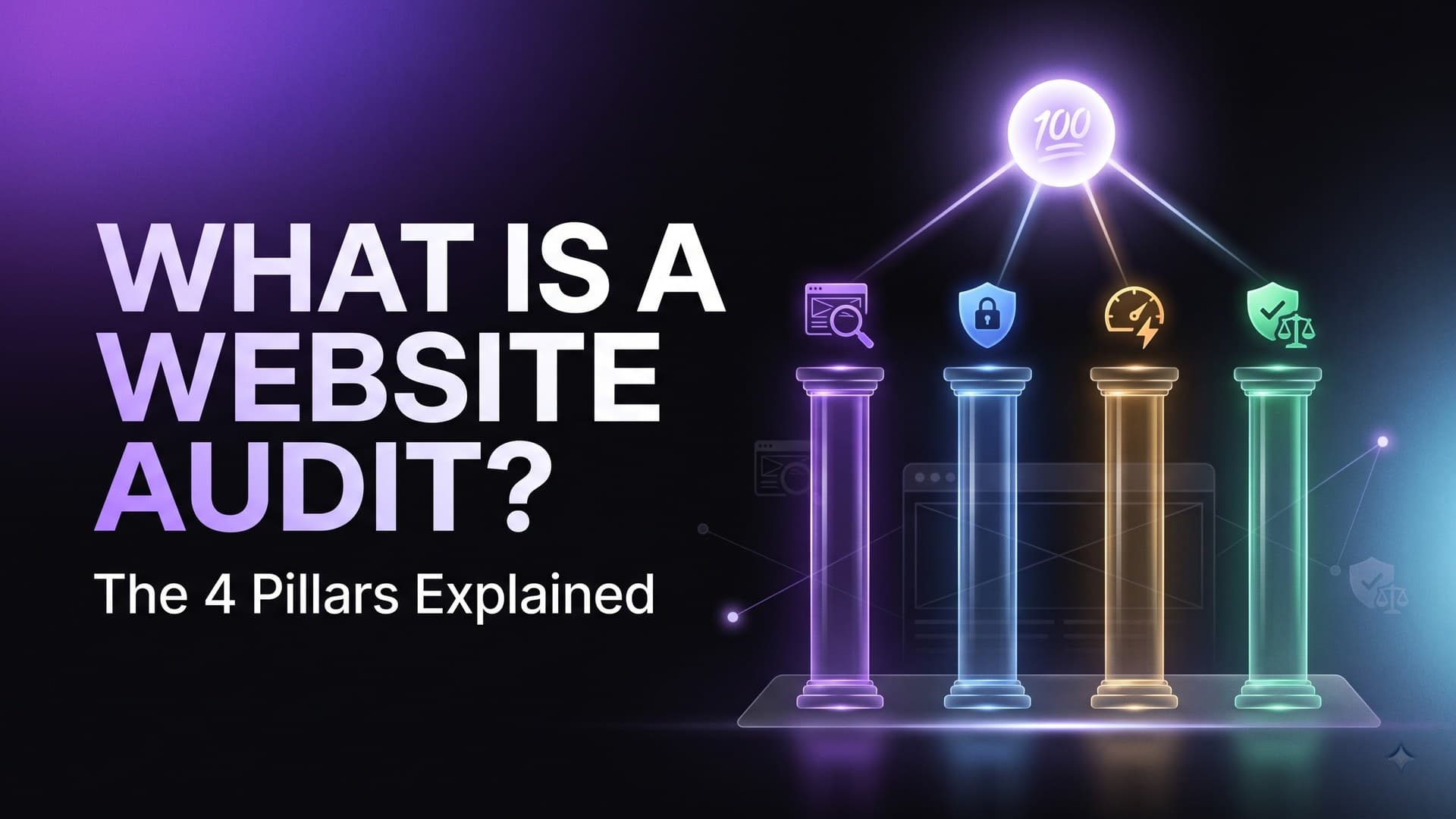
In 2026, a complete website audit covers four distinct areas: SEO, security, Core Web Vitals performance, and legal compliance (GDPR, CCPA, DPDP). Missing any one of them leaves real problems unchecked. Tools like AuditAI run all four simultaneously — no login required.
What Is a Website Audit?
A website audit is a systematic analysis of your website's technical health, content quality, security posture, and compliance status. Think of it as an MOT test for your website — it flags what's broken, what's missing, and what needs improving.
Unlike a manual review, an automated website audit tool checks dozens of factors simultaneously in seconds. A good free website audit tool should identify: broken links, missing meta tags, poor Core Web Vitals scores, absent security headers, and privacy compliance gaps — all in one report.
The 4 Pillars of a Complete Website Audit
1. SEO Audit
An SEO audit checks every on-page and technical factor that affects how Google ranks your pages. A thorough SEO audit includes:
- Title tags — present, unique, correct length (50–60 characters)
- Meta descriptions — present, compelling, under 155 characters
- Heading structure — single H1, logical H2–H6 hierarchy
- Canonical URLs — preventing duplicate content penalties
- Open Graph tags — correct social sharing previews
- Structured data (JSON-LD) — eligible for rich results
- Image alt text — descriptive, keyword-relevant
- Internal linking — pages are interconnected and crawlable
2. Security Audit
A website security audit checks whether your server is sending the correct HTTP security headers — the invisible signals that protect visitors from cross-site attacks, clickjacking, and data theft. Key headers to check include:
- Content-Security-Policy (CSP) — prevents XSS attacks
- Strict-Transport-Security (HSTS) — enforces HTTPS
- X-Frame-Options — prevents clickjacking
- X-Content-Type-Options — stops MIME sniffing
- Referrer-Policy — controls referrer data leakage
- Permissions-Policy — restricts browser feature access
Most free security scanners only check one or two headers. A complete website security audit tool checks all of them and gives you a security score — AuditAI checks 13+ security headers with no login required.
3. Core Web Vitals & Performance Audit
Google uses Core Web Vitals as a direct ranking signal. A performance audit measures:
- LCP (Largest Contentful Paint) — how fast your main content loads. Good: under 2.5s
- CLS (Cumulative Layout Shift) — how much your page jumps around. Good: under 0.1
- INP (Interaction to Next Paint) — how fast your page responds to clicks. Good: under 200ms
Beyond Core Web Vitals, a performance audit checks render-blocking resources, image optimisation, unminified CSS/JS, missing Cache-Control headers, and server response times.
4. Compliance Audit (GDPR, CCPA, DPDP)
A compliance audit checks whether your website meets its legal obligations under major data protection laws:
- GDPR — EU law. Requires cookie consent, privacy policy, HTTPS, no exposed PII
- CCPA — California law. Requires "Do Not Sell My Data" option for qualifying businesses
- DPDP Act — India's Digital Personal Data Protection Act. Requires consent, data fiduciary obligations
Who Needs a Website Audit?
Every website benefits from a regular audit — but it's especially important if:
How to Run a Free Website Audit (No Login Required)
You don't need an expensive subscription to audit your website. AuditAI is a free website audit tool that checks all four pillars — SEO, security headers, Core Web Vitals, and GDPR/CCPA/DPDP compliance — in a single scan with no signup required.
- Go to auditai.fyi
- Paste your website URL into the scan bar (no https:// needed)
- Click "Scan Site" — results appear in under 30 seconds
- Review your SEO score, security score, performance score, and compliance status
- Click any issue to see the AI-generated fix
Unlike tools that only check one aspect of your site, AuditAI gives you a combined website SEO and security audit in one place — making it one of the few free website audit tools that checks everything without requiring an account.
How Often Should You Audit Your Website?
For most websites, a monthly audit is ideal. Run an immediate audit whenever you:
- Deploy a new version of your site
- Add new third-party integrations or scripts
- Experience a sudden drop in search rankings
- Receive a compliance inquiry from a user or regulator
- Change hosting providers or update your server configuration
Frequently Asked Questions
What are the 4 pillars of a complete website audit?+
How often should you audit your website?+
What security headers does a website security audit check?+
Do I need a login to run a website audit?+
Run a Free Website Audit Now
AuditAI is the free website audit tool that checks SEO, security headers (CSP, HSTS, X-Frame-Options), Core Web Vitals (LCP, CLS, INP), and GDPR/CCPA/DPDP compliance — all in under 30 seconds. No login, no signup, no credit card.
Run Free Website Audit →