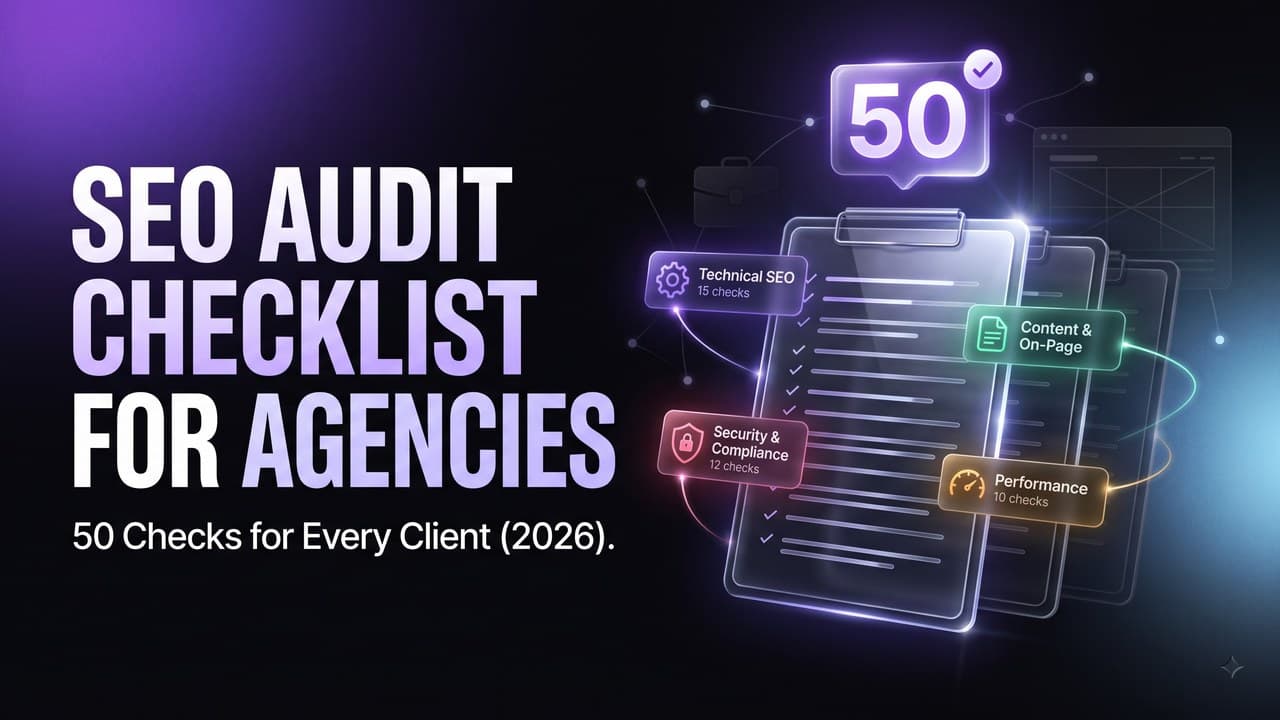
SEO Audit Checklist for Agencies: 50 Checks for Every Client
The complete agency SEO audit framework for 2026. 50 checks across technical SEO, security headers, GDPR compliance, on-page optimization, and Core Web Vitals — with tools to automate every step. Automate the data collection phase with AuditAI's free website audit at auditai.fyi.
May 2026·12 min read·AuditAI Team
01
Technical SEO Checks (15 checks)
- 1Title tag present, unique, and under 60 characters
- 2Meta description present, unique, and 140–160 characters
- 3H1 tag present — exactly one per page, contains primary keyword
- 4Canonical tag present and self-referencing on all indexable pages
- 5robots.txt accessible and not blocking critical resources
- 6XML sitemap accessible at /sitemap.xml and linked in robots.txt
- 7HTTPS enforced — all HTTP URLs redirect to HTTPS
- 8No mixed content (HTTP resources loaded on HTTPS pages)
- 9No accidental noindex on important pages
- 10Open Graph tags (og:title, og:description, og:image) present
- 11Twitter card tags present
- 12Structured data / JSON-LD schema markup present
- 13Broken internal links — no 404s in internal navigation
- 14Mobile-friendly and responsive design
- 15URL structure — clean, descriptive, no dynamic parameters on key pages
02
Security & Compliance Checks (12 checks)
- 1Content-Security-Policy (CSP) header present
- 2HTTP Strict-Transport-Security (HSTS) header with max-age ≥ 1 year
- 3X-Frame-Options header present (DENY or SAMEORIGIN)
- 4X-Content-Type-Options header set to nosniff
- 5Referrer-Policy header set appropriately
- 6Permissions-Policy header restricting unused browser APIs
- 7Cookie consent banner or notice present
- 8Privacy policy page accessible and linked in footer
- 9Terms of service page accessible
- 10No API keys, tokens, or credentials exposed in page source
- 11Admin login page (/wp-admin, /admin, /login) protected or not publicly indexed
- 12GDPR/CCPA compliance — data collection disclosed, opt-out available
03
Content & On-Page Checks (13 checks)
- 1Primary keyword present in title tag
- 2Primary keyword present in H1
- 3Primary keyword present in meta description
- 4Keyword density between 0.5–2% (not stuffed, not absent)
- 5Word count appropriate for content type (blog: 1,000+, landing page: 500+)
- 6All images have descriptive alt attributes
- 7No large images without compression (aim for <200KB per image)
- 8Internal links present — at least 3 internal links per page
- 9External links to authoritative sources (adds E-E-A-T signals)
- 10Page has a clear, prominent call-to-action
- 11Content freshness — date visible and within 12 months for time-sensitive topics
- 12No duplicate content — page content unique vs. other pages on the site
- 13Readability — content scannable with subheadings, bullets, and short paragraphs
04
Performance Checks (10 checks)
- 1Largest Contentful Paint (LCP) under 2.5 seconds
- 2Interaction to Next Paint (INP) under 200ms
- 3Cumulative Layout Shift (CLS) under 0.1
- 4Time to First Byte (TTFB) under 800ms
- 5Total page weight under 2MB
- 6No render-blocking JavaScript in <head>
- 7Images using modern formats (WebP or AVIF)
- 8Browser caching enabled for static assets
- 9CDN in use for global delivery
- 10No unused CSS or JavaScript (Lighthouse coverage audit)
Frequently Asked Questions
How long does a client SEO audit take?+
With automated tools, the data gathering phase takes 5–10 minutes per site. Interpreting results and writing a client-ready report typically takes 1–2 hours. Using AuditAI's white-label report tool, you can generate a branded printable report in under 60 seconds — leaving your time for strategic interpretation rather than data collection.
What tools do agencies use for SEO audits?+
Most agencies combine: a technical crawler (Screaming Frog or AuditAI), a backlink tool (Ahrefs or SEMrush), Google Search Console for real ranking data, Google PageSpeed Insights for Core Web Vitals, and a security checker. AuditAI covers technical SEO, security headers, GDPR compliance, and performance in a single scan — significantly reducing the tool stack needed for comprehensive audits.
How do I present SEO audits to clients?+
Use the AuditAI white-label report tool to generate a branded PDF-ready report with your agency name. For the presentation, lead with the overall score and 3 critical issues, then present fixes grouped by priority (quick wins vs. long-term). Avoid technical jargon — translate every issue into business impact (e.g. 'missing meta description reduces click-through rate by ~30%').
Should agencies use a white-label audit tool?+
Yes — if you're doing more than 3 audits per month. White-label tools save 2–3 hours per client on report generation, ensure consistent formatting across all client deliverables, and let you present a professional branded report rather than a raw data export. AuditAI's white-label report is free to use for any number of clients.
How much should agencies charge for SEO audits?+
Standard rates range from $500–$2,500 for a comprehensive audit depending on site size and scope. Quick technical audits for small sites run $200–$500. Enterprise audits with custom deliverables and presentation start at $3,000. The key is pricing based on the value of issues found — a single critical error fix can be worth thousands in recovered traffic.
Run a free website audit — generate your first white-label report
AuditAI is a free site audit tool with white-label client reports built in. Automate 50+ checks — SEO audit, security headers, Core Web Vitals, GDPR compliance — and deliver branded, printable reports to any client at no cost. No login required at auditai.fyi.
Create Free Client Audit Report →